
Lance Lambert on what constitutes a Christian, how God produces Christians through the cross, and our responsibility in salvation. Based on John 3 and Isaiah 53.
Read the Transcript
What is a Christian?
Three Essential Questions
This evening, three questions. And I hope, trust by the grace of the Lord Jesus to be able to answer those questions and in so doing may be enabled by Him to point some to a clearer understanding of what the Lord Jesus would do within us.
I have three questions. I believe they're all important. The first is, what is a Christian? What is a Christian? What constitutes a Christian? What marks him out? How can we know if we really are Christians?
And then secondly, I would like to ask the question, how can a holy God produce Christians? How can God Almighty lay hold of us, we who are so sinful by nature, so rebellious by nature, so utterly self-centred by nature? How can God lay hold of us? How can He produce Christians?
And lastly, what responsibility have I in becoming a Christian?
The Definition of a Christian
The Lord Jesus and Nicodemus
Firstly, what is a Christian? In John chapter three, we find that the Lord Jesus speaks to the leading teacher and scholar of His day. A man who was renowned for his piety and for his knowledge of scriptural things, Nicodemus. And Nicodemus, just because he was so well known, because of the position that he held in the nation, because of his name and his reputation, he came to the Lord Jesus at night, and he asked the Lord Jesus something about Himself.
And the Lord Jesus, as you, I think, will know from the story in John chapter three, went straight to the heart of the matter. It is one of the loveliest things about the Lord Jesus that He never ever wastes words. I'm afraid many of us preachers, we waste words. But one of the most beautiful things about the Lord Jesus is that He gets to the point immediately, gently, firmly, decisively. He always comes right down to the need of whoever it is.
Sometimes people try to deceive the Lord Jesus. Like the woman at the well of Samaria. She tried to make out that she knew an awful lot about spiritual things. She tried to get draw Him out along the line of argument about the background of her people and the Jewish people. But He wouldn't have it. And with one question and her answer and His reply, He got right down to the root of her problem. And she was shattered in an instant. And from that point she taught reality; she taught the truth. And He was able to meet her at the point of her need. In the same way the Lord Jesus, with every single instance in the New Testament—and we thank God ever since, in every succeeding generation and century, whenever the Lord Jesus has started to lay His finger or His hand upon a human being, He never wastes words. But slowly and irrevocably He gets down to the real root need within us.
Sometimes we try to deceive Him, sometimes we put up great arguments. We excuse ourselves; we talk religiously. We try to make out that we're not really so bad as everyone else. But the Lord Jesus, sooner or later with each one of us, gets us right down to rock bottom where we say, Lord, I cannot, Lord, I am unable, Lord, I am a sinner. And there comes a point at which we come to the place where we speak of ourselves as the sinner. And then the Lord meets us.
The Necessity of Spiritual Birth
When Nicodemus came to the Lord Jesus, he, of course was a very pious man. He was a very good man. He wasn't immoral, he wasn't indecent, he wasn't a bad man. He was a man who was known everywhere for his piety and his goodness. And when he came to the Lord Jesus by night, stealthily, secretively, as he came to Him, he began to discuss. He wanted to find a little bit more out, a little bit more about the background of the Lord Jesus. Who is this man? He obviously is sent of God. Nicodemus was far too honest and sincere a man to be able, like so many of the religious leaders of his day, to evade the issue and wipe the Lord Jesus off as some fanatic amongst the people. He realised that the Lord Jesus had got something. He was a marked man. He was singular, unique.
The Lord Jesus never wasted any words talking about His background or where He came from or anything else with Nicodemus. He went straight to the point, and He said to Nicodemus, "Truly, verily, verily," or we would say today, "The thing is this, Nicodemus, except a man be born anew, he cannot see the kingdom of God."
I think Nicodemus was shattered. I don't think he expected anything quite like that. Yes, a discussion, a theological discussion. A discussion about the history of God's people. A definition of the mission of the Lord Jesus. Yes, but not to be told, "Nicodemus, Nicodemus, it doesn't matter who it is or what you are. Unless a human being, every human being is born anew, whoever they are, whatever they are, they cannot see the kingdom of God." That was Nicodemus' problem. That was his need. He may not have known it, but that was his greatest need.
What is a Christian? A Christian is someone who is born of God, spiritually begotten of God. That is a Christian. Nothing more and nothing less than that.
Main Scripture: John 3 (Jesus and Nicodemus)
Key Verse: John 3:3 - "Except a man be born anew, he cannot see the kingdom of God"
Supporting Scriptures: Isaiah 53, Numbers 21:8-9, 1 Peter (begotten again), 1 Corinthians 6:17
The Testimony of Scripture
The whole New Testament bears that out. It is one of the greatest tragedies of our day that with all our education and our knowledge and our advance and progress, there are very few people who could define what a Christian is. If you and I were to go down to the river this evening and were to speak to quite a few people, we should have a variety of answers to our question: what do you think is a Christian? I doubt very much if we would find one in perhaps a hundred who could tell us that according to the word of God, a Christian is someone who has been born of God.
And yet the Lord Jesus told us that this was that which constituted a Christian. Now you can have a lot of Christian things, you can have a lot of Christian additions without having the one necessary thing, the one vital thing that constitutes a man or a woman a Christian. There are multitudes of people who say their prayers, who read their Bible, who go to church and many other things. They believe that in so doing they are Christians. But the word of God condemns such, not necessarily the motive of such. For the motive may be very good and sincere, but it condemns the idea that things such as that constitute a man or a woman a Christian.
What a Christian Is Not
What then can we say is a Christian? It would be easier if we were to tell ourselves quite plainly and to make clear to ourselves what a Christian is not. Sometimes the easiest way of getting to something, a clear understanding of the matter, is to clear the ground of all the rubbish.
Well, we can say two or three things. We can say first of all that a Christian is not someone who is born in a so-called Christian country. That is quite clear. Many people say that they're Christians because they're born in England. I only heard the other day of a lady who was quite annoyed and angry that an Englishman had been described as someone who was not a Christian. A good man, but not a Christian. She was most annoyed about it; thought it was quite preposterous that it should be even suggested that anyone who was an Englishman was not a Christian.
A Christian is not someone who's born in a so-called Christian country. It would put our dear brothers and sisters in some other countries that are anything but Christian in a very, very poor light. It is not something national. It is not something to do with natural birth. There are some people, of course, who believe that a Christian is someone who's born in a Christian family. Your father and your mother were Christians. They were two Christians. And because they were Christians, you are a Christian. But nowhere in the Bible does it even suggest the possibility of naturally transmitting our salvation to our children. You are not saved by virtue of having Christian parents. The Lord Jesus said that we must be born again, born of God if we would be Christians.
Then again, we can say some other things about what a Christian is not. We can, for instance, dismiss the idea immediately as so illogical that a person who is educated is a Christian. I don't think we need to stay with that for a moment. Or for that matter, do we need to stay very long with another idea which is much more deeply rooted. And that is that if a person is a good person, it doesn't matter what else. If they are a good person, then they are a Christian.
But that is just where many make their greatest mistake. They make their greatest mistake on that very point. The Lord Jesus never said that good people were Christians, and bad people were non-Christians. He never said that. Indeed, again and again He said that He had come into this world not to call the righteous to repentance, but the sinner. It is not a question of whether we're good. Oh, we thank the Lord for every good person. That's a wonderful thing to meet good people, people who do good things, and are good and decent, moral people. But if we think that by so-being we are constituted Christians, we have a terrible awakening coming one day. It is not that.
The Inadequacy of External Religion
Nor is it being religious. If we think that by rites or ceremonies or by many other means we can be constituted Christians, we stand condemned by the word of our Lord Jesus Himself. Nothing without can possibly do anything within. You must have something within to make you a Christian. Becoming a Christian, being a Christian, is wholly at the beginning, something within you, within. And it doesn't matter whether I've been baptised or christened or confirmed, or whether I take the Lord's table or whether I belong to a church or a chapel. Those things in themselves cannot do something inside of me. We make a terrible mistake if we think that those things can constitute us Christians.
The Lord Jesus put it in such beautifully simple language to the greatest religious leader and theologian of His day. He said, "Verily, verily, I say unto you, except a man be born anew..." So, a Christian is someone who's born anew.
The Nature of Spiritual Birth
What does it mean to be born anew? It means simply that you're born of God just as you were born of your parents. You came to this world some little, small bundle of human life. You were a new human being. I belong to my parents, my father and my mother. When I was born of them, I wasn't what I am now. I didn't even look as I look now. I was just a little something that was taken up in the arms. That had to be carried here and there, that had to be looked after in order to live. I was just something, a little bundle of human life. I came out of my parents. I was produced by my parents. There is a sense in which I can truly say I had nothing to do with it whatsoever. It was outside my realm. It was outside my scope. And yet I came into the world. I belong to them. I can't engineer a birth. I couldn't engineer my birth. I came. I was born of them. And so I took their name. I became the so and so generation of the Lamberts. I am an extension of the Lamberts. I am the 20th century extension of the Lambert family. Begotten by my father and mother.
The Lord Jesus said to Nicodemus when he asked this question, "Can I again enter into my mother's womb and be born?" He said, "Of course not. That's not the point. The point is this. Just as physically you were born of your father and your mother, so the same miracle spiritually has got to take place. So that you are born of God." Something inside happens. Something within happens. And you are suddenly produced. A child of God.
Union with God
A child of God! Born of God. Later on, Peter, writing his tremendous letter, says, we have been begotten again unto a living hope. Some quite a number of years later, begotten again unto a living hope. And again in another part of his letter, he says, we have been begotten again not of corruptible seed, but of incorruptible. That means that this birth is eternal.
What is a Christian? A Christian is someone who has been born of God. Let me put it another way. Something of God for the first time has been deposited in you. For the first time, you are linked in an eternal union with God. You, a human being, and God, the almighty God, the eternal God, have been fused together. He that is joined to the Lord is one spirit. What is a Christian? Oh, the miracle of it. A Christian is not someone who goes to church. A Christian is not someone who just reads their Bible. A Christian is not someone who gets on their knees and prays in a certain way. No, a Christian is someone who is joined to God. God is joined to them. They have been born of God. They are children of God. They are now God's family. They are His offspring. They belong to Him for all eternity.
The human family was instituted. Marriage and the human family were instituted. Not as something eternal, but as something temporary, something transient. As a shadow of an almighty reality. What is the almighty reality? The almighty reality is this. God is our father. God wants a family. God wants to produce us as His children.
The Etymology and Meaning of "Christian"
What is a Christian? What does the name Christian mean? The name Christian, as I think many of you, most of you, if not all of you will know, came from the little word Christ's ones. Christ's ones. People couldn't describe these people. They looked at them in Antioch. They watched them. They watched their behaviour. They watched their conduct. They watched. They listened to their speech. They saw these people changed. We knew them, we lived with them. We've had our dealings with them, but they've completely changed. Yes, they're the same people, and yet they've changed. What can we call them? What can we call them? And they thought and they thought. And in the end they said, we can only describe them in one way. They are of Christ. They are like Christ. They are Christ ones. Christ is in them. That is the only way we can describe them. There is a family likeness. There is something about them which means that there is a common relationship.
What a wonderful thing it is when we can pick out a Christian. It is a wonderful thing where we can pick out a Christian. The greatest joy that I've ever had is when someone's come up to me in a train or in a hall or in some other place and just say, very simply, "Excuse me, you're a Christian, aren't you?" That's one of the greatest joys. What does it mean? It's nothing in me. It's nothing in you. It's a family likeness, that's all. There's something that someone scented out, something that someone has defined. And they say, it's Christ. It's Christ. And it doesn't matter whether the colour is yellow, black or white. Somehow or other, it's just Christ. That's all.
Well, that's a wonderful thing. What does it mean to be a Christian? It means that Christ has come to live within us and we are now joined with Christ. That is what it means to be a Christian.
The Poverty of Alternative Definitions
How paltry all those other things are that people think constitute us Christians when it's seen in that light. How paltry. Do you mean to tell me that the country of my birth can constitute me a Christian? I thank God for the country of my birth, but it can't constitute me a Christian. You mean to tell me that my natural parents, after the flesh, can constitute me a Christian? I'm sorry, but they can't. It's a fact. They may be godly. They may be holy. They may be pious, they may be zealous, but they can't constitute me a Christian. They can point me to Christ, they can cover me and guard me when I'm young, too young to know my own mind, but they can't constitute me a Christian.
Those things seem very paltry and believe me, so does the religious side of it, if we think that it's just simply being religious. Well, there we are. A Christian is someone who's been born of God. What a miracle.
Historical Evidence of Spiritual Birth
Every great new phase in the history of God's people has begun with the recovery of this simple truth. It doesn't matter where you turn, every single phase has begun with a recovery of that truth. It doesn't matter where you turn in the world and in history, you will discover this simple fact that wherever you have found a man or a woman who has been born of God, they have turned the world upside down in the measure in which they've gone on with the Lord. And that doesn't matter whether you take Wycliffe or whether you take Luther or whether you take the Wesleys, or whether you take George Fox or whether you take Mary Slessor of Calabar who laid the foundation of a state, or whether you take David Livingstone or whether you take C.T. Studd, whether you take Hudson Taylor or whoever you take, wherever you take them, in whatever generation you take them, if you discover a man who's been born of God's spirit and not merely religious, you finally turned the world upside down.
They pioneered a trail in this country. With all our social standards, with all our culture and our education, what do we owe it to? We owe it to people like Florence Nightingale, Elizabeth Fry, Lord Shaftesbury, and a multitude of others. Well, those people were joined to God.
The Divine Method of Producing Christians
But I want to ask a question. How then, if we know what a Christian is, how on earth is it not presumptuous to say that God can live inside of us sinful, failing, frail, weak human beings? Do you mean to tell me that God can actually come and live within me? That somehow or other God can get inside of me? That I can be brought, if I may put it almost irreverently, inside of God, that somehow, we two can become one?
The Typology of the Brazen Serpent
How can God produce a Christian? How does He do it? Well, you read Isaiah 53 this evening, did you not? How has God found a way? The Almighty God, the eternal God, the Holy God. How has He found a way with sinful, rebellious humanity? How has He found a way? This is the way He has found. He Himself has taken human nature upon Himself and has become one of us, and yet without sin, and has taken into His own body the thing that has wrecked humanity. He allowed the thing that wrecked humanity to wreck Him. He became the great destroyer of humanity. The thing that has destroyed humanity, He Himself became.
When Nicodemus asked this question and was answered by the Lord so simply, he went on to ask that other question. "How can this be? Can I enter into my mother's womb again?" "No," said the Lord Jesus, "you must be born of the spirit. You must be born of water and of spirit." Then Nicodemus must have been so overwhelmed that he said, "But how?"
The Lord Jesus said a remarkable thing. He said, "Nicodemus, you know, in our history, in the history of our nation, there was a time when the people sinned. And Moses was told to make a brazen serpent. And when he lifted it up, whoever looked at that brazen serpent lived. And whoever did not, died. Nicodemus, even as Moses lifted up the serpent in the wilderness, so must the Son of Man be lifted up."
Now, for those of you who know your Bibles, you know that throughout the whole Bible, the serpent is a symbol of only one thing. It is the symbol of Satan. What did the Lord Jesus mean when He identified Himself with the serpent? What did He mean when He said He must be lifted up like that? What did He mean? He meant simply this, that He must Himself become the very thing that has destroyed humanity, and in so doing might be able to release humanity from its grip. He must become the great substitute. He must become the great atonement. He must gather into Himself the thing that has destroyed all, become it.
The Doctrine of Substitutionary Atonement
So Paul later said this wonderful thing. He said, "Him who knew no sin, God made to become our sin, that we might become the righteousness of God." Now listen. Do you understand what that means? You may not be able to believe it but at least understand what it means. It means that God's son Christ became our sin. He became the thing. He became sin. He knew no sin. That was His difference to the rest of us. That was His uniqueness. He was not sinful. He knew no sin. He became sin in order that we might become the righteousness of God. Do you see an exchange? He became our sin, that we might become His righteousness.
How can God produce a Christian? By Himself, incarnate. By the Word, becoming flesh and dwelling amongst us. By the eternal Word, offering Himself up on the cross for us, as us, in our place.
This is the basis, the eternal foundation for God's dealings with humanity. There is no other foundation. If you try to find any other foundation, God will not accept you. This is the foolishness of the cross. This is the scandal of the cross. This is the stumbling block of the cross. This is the offensiveness of the cross. People would like something very intellectual. People would like to be able to sign on a dotted line. People would like to be able to do something. But to accept the offensiveness of the cross is something that hits at our pride. God's way is the cross.
The Prophetic Description of Substitution
Listen.
Surely He hath borne our griefs and carried our sorrows. Yet we did esteem Him stricken, smitten of God and afflicted. But He was wounded for our transgressions. He was bruised for our iniquities. The chastisement of our peace was upon Him. And by His stripes we are healed. All we, like sheep, have gone astray. We have turned every one to his own way. But the Lord hath laid on Him the iniquity of us all.
How does God produce a Christian? By being wounded. By being bruised. By stripes. By the chastisement of His people.
The Depth of Christ's Suffering
I have thought, wounded, yes. I know the Lord Jesus was wounded. Bruised, yes. No man can be nailed to a tree without being bruised. That word doesn't mean the bruise you get when you knock yourself on a door or on the table. That's the kind of bruise you have when you've been mangled after a car crash. Bruised, wounded, beaten.
But I said to myself, what is the chastisement of His peace? The Son of God. Did He ever know anything about the chastisement of my peace? When I have a conscience, when I can't sleep, when I worry, when I know I've done wrong, when I know I'm a sinner, when I know that I'm just not right—does He know anything about that? He who was so right with God? He who was so perfect. The chastisement of my peace was upon Him. There came a point on the cross when the Lord Jesus who plumbed the depths of sin and evil, and knew what it was, had a stricken conscience. "My God, My God, why hast Thou forsaken Me?" The chastisement of our peace upon Him. The chastisement. The chastisement of our peace upon Him—my!
You mean to tell me that you can be a Christian a cheap and an easy way when it costs God everything? The thing's a pernicious lie! You and I can only become Christians by the way God has given us, the way of a crucified Christ.
Wounded, bruised, beaten. The chastisement of our peace upon Him, a stricken conscience.
The Human Condition
Can you admit that you and I are like sheep? From my observation, I can. We are like sheep, silly sheep. All we, like sheep, have gone astray. We have each one turned to our own way. We deserve to be left. And I think of the way the Lord wrestles with us, the way the Lord pleads with us, the way the Lord stands astride our path. And we will not have it. We leave Him. We turn away from Him. We go our own way. We deserve to be left. But the Lord has laid on Him the iniquity of us all.
Now do you see God's way? How does God produce a Christian? By the way of a crucified Christ. May I put it another way to bring it home to you very simply? By the way of a crucified God. A God who allowed Himself to be nailed by His own creation to a tree which He Himself had created. That is the weakness of God, and that is the way in which He produces Christians.
What about sin? What about self? That's all right. It was dealt with at the cross.
Human Responsibility in Salvation
Well, if I go on like this, we should be here all night. But I have another question. I will answer this swiftly because I think it's far more important for us to know how God produces a Christian than to know even our responsibility. For to become a Christian is wholly within the sovereignty of God. I can do nothing but cry. When I cry, God hears.
The Divine Satisfaction
What is my responsibility? What is my responsibility? Listen to the beautiful words of Isaiah the prophet.
When Thou shalt make His soul an offering for sin, He shall see His seed. He shall prolong His days and the pleasure of the Lord shall prosper in His hand. He shall see of the travail of His soul and shall be satisfied.
How can you and I be born of God? Have we any responsibility at all in this matter? Can we take any action?
The Response of Faith
We can only do one thing. We must leave our ideas, our rather glorified ideas and easy ideas, of what makes a Christian. We must leave them. And we must come simply to the Lord as one who has by his own or her own attitude made the cross a necessity. We must come, therefore, as contrite sinners to an almighty God. We must make no excuse. We must not try to evade any issue. We must come and we must see that our sin, my sin, nailed Him to the tree. We must see that you and I, we have a personal responsibility in the death of the Lord Jesus Christ, it was for us. For us.
We come like that. We don't come to try and make out that we should be alright or to try and make God believe that we are better than we really are. We must come simply, just as we are. Just as we are. And we must, in faith, take Christ crucified as the way of God. The way of God, by which I can reach Him and by which He can reach me. The Lord Jesus said, "I am the way, the truth and the life." That's the way.
How? You make His soul your offering for sin. No more excuses, no more dilly-dallying, no more evasion. Simply, quietly, definitely take Him as your offering for sin. The one who died in your place. The one who answers to God for you.
The Person of Salvation
Well, that's the end of my three questions. What is a Christian? How does God produce Christian? What is our responsibility? I hope you haven't been too hot whilst listening, but I would like you, if you have any question at all, to come and ask me anything that would make it clearer or more plain to you.
You just take the Lord Jesus Christ, this evening, as your salvation. May I close with this? God's salvation is not a thing. It is a person. You accept the person and you have the salvation. You can't have the salvation without the person. The person is the salvation. Jesus, the salvation of God.
Take Him, open your heart to Him, receive Him. Surrender to Him. Abandon yourself to Him and you'll become a child of God. For to as many as received Him, to them gave He the authority to become children of God.
Frequently Asked Questions
What does it mean to be born again according to Jesus?
According to Jesus' teaching to Nicodemus in John 3, being born again means experiencing a spiritual birth from God, just as one experiences physical birth from parents. It's not a physical rebirth but an inward spiritual miracle where God deposits His life in a person, creating an eternal union between God and that individual. This spiritual birth is the only qualification for being a Christian.
Can a good person be a Christian without being born again?
No. According to this teaching, being moral, good, decent, or religious does not make someone a Christian. A person may be educated, attend church, pray, read the Bible, and do good works, but without being born of God's Spirit, they are not truly a Christian. Jesus emphasized that even Nicodemus, a renowned religious leader and good man, needed to be born anew to see the kingdom of God.
What does the brazen serpent teach us about salvation?
Jesus used the account of Moses lifting up the brazen serpent in the wilderness (Numbers 21) as a picture of His crucifixion. Just as the serpent symbolized the very thing that was destroying Israel (sin), Jesus became sin for us on the cross. Those who looked in faith to the brazen serpent lived; likewise, those who look in faith to Christ crucified receive eternal life. It illustrates substitutionary atonement—Christ becoming our sin so we might become His righteousness.
What is my responsibility in becoming a Christian?
Our responsibility is to come to God as contrite sinners, abandoning our own ideas of what makes us acceptable to God. We must recognize that our sin made the cross necessary, and in faith, take Christ crucified as our offering for sin. We must receive Him, open our hearts to Him, surrender to Him, and make His soul our offering for sin—accepting Him as the one who died in our place and answers to God for us.
Why is the cross offensive or scandalous?
The cross is offensive because it confronts human pride and rejects all human effort or achievement as a means of salvation. People prefer something intellectual, ceremonial, or based on their own good works. But God's way requires accepting that Christ became our sin, was wounded, bruised, and suffered with a stricken conscience for us. The cross declares that even good, religious people cannot save themselves—they must accept salvation as a free gift through Christ's sacrifice alone.
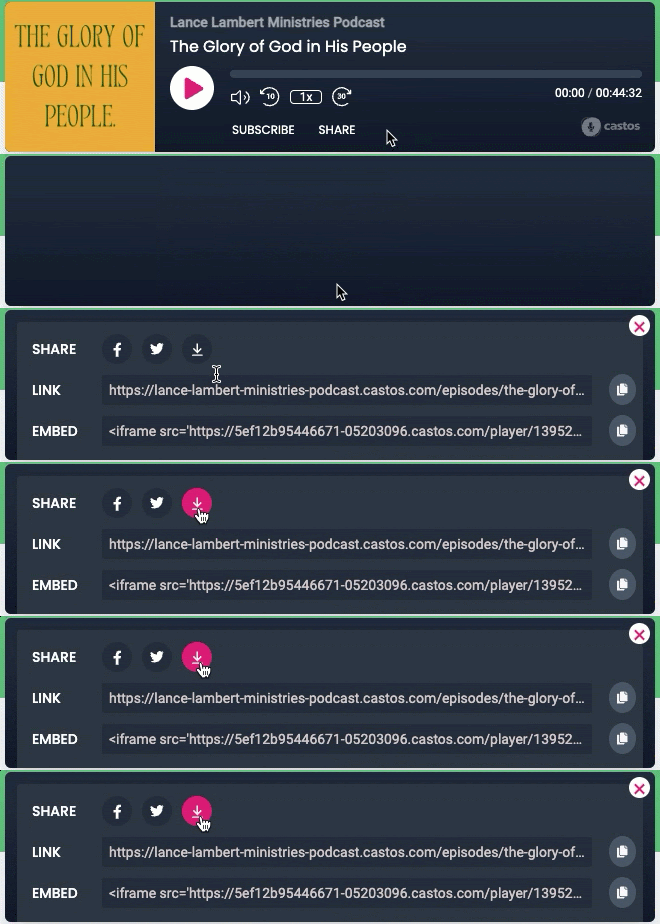
How to Download the Podcast:
About Lance Lambert
Lance Lambert was one of the most distinguished Bible scholars and speakers in Israel in our day. He had an itinerant teaching ministry worldwide.
Born in 1931, Lance grew up in Richmond, Surrey and came to know the Lord at twelve years of age. He entered the school of African and Oriental studies at London University to prepare for work in China. In school, he studied Classical Chinese, Mandarin, Oriental Philosophy and Far Eastern History. However, the revolution closed the door to European missionaries and his entry into China.
In the early 1950’s, Lance served in the Royal Air Force in Egypt. Later, he fellowshipped with the assembly at Halford House Christian Fellowship in Richmond, England.
Having discovered his Jewish ancestry, Lance became an Israeli citizen in 1980. He had his home next to the Old City of Jerusalem. His father and many members of his family died in the Holocaust. At last, Lance went to be with the Lord in 2015.
Lance is noted for his eschatological views, which place him in the tradition of Watchman Nee and T. Austin-Sparks. He produced a widely appreciated quarterly audio recording called the Middle East Update. The MEU gave his unique perspective on current events in the Middle East in the light of God’s Word. He has written numerous books and is presenter of the video production, Jerusalem, the Covenant City.
Lance desired for his ministry to continue to be available to future generations when he went on to be with the Lord. This is our desire as well. We hope to preserve the heart of the Lord shared through Lance. May many more may be encouraged and prepared as we wait together for our Lord’s return!